Do You Really Need Gigabit Internet?
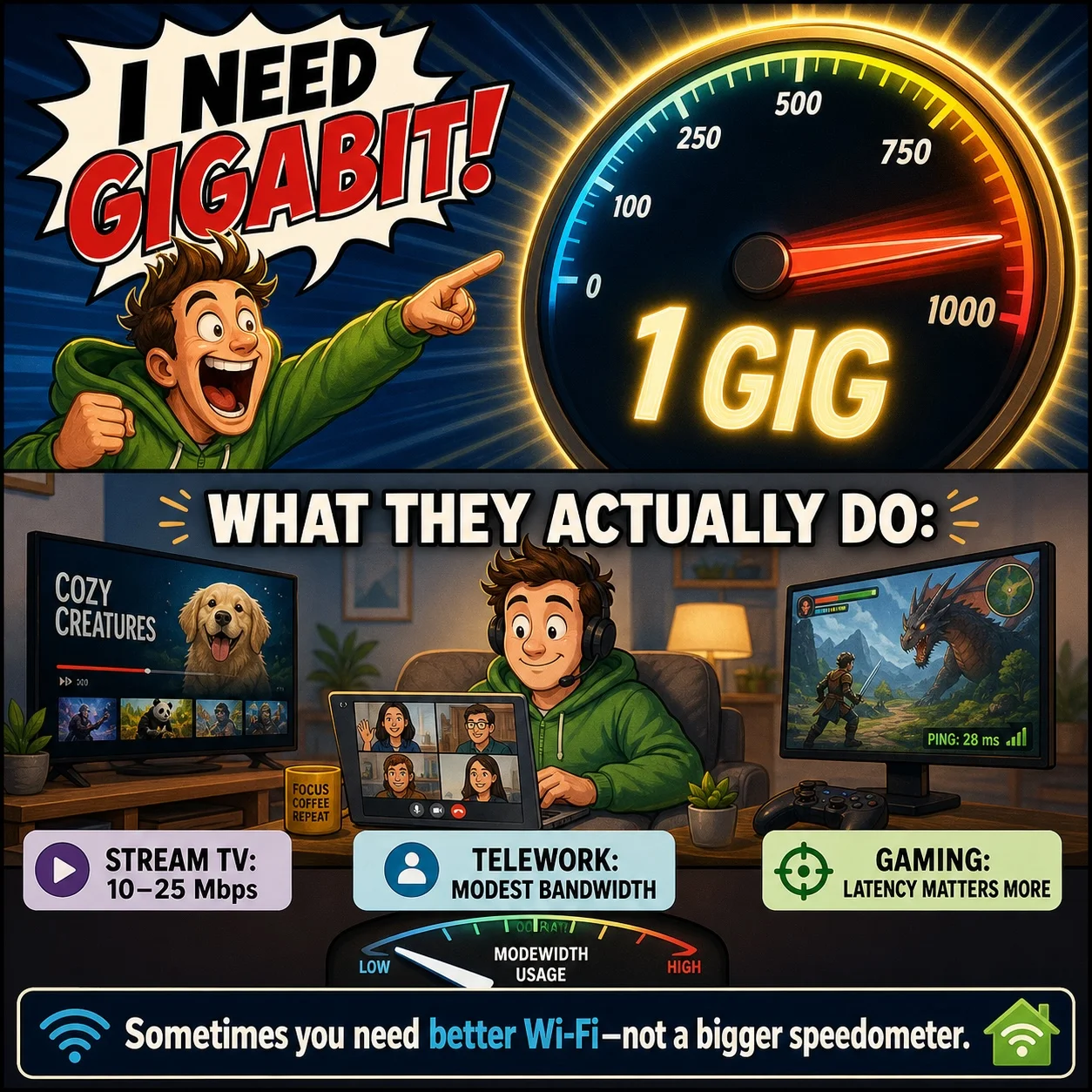
Gigabit internet sounds impressive—and for some households, it’s absolutely worthwhile. But internet speed is only one part of a good online experience. Depending on how you use your connection, upgrading to gigabit service may not fix slow Wi-Fi, video buffering, gaming lag, or dropped calls.
Before choosing a plan, it helps to understand the difference between bandwidth, latency, and Wi-Fi performance.
How Much Speed Does Streaming TV Use?
Most streaming services use approximately:
-
5–10 Mbps for HD video
-
15–25 Mbps for 4K video
-
Less bandwidth for standard-definition video
Even several televisions streaming simultaneously may use only a fraction of a gigabit connection. For example, four 4K streams at 25 Mbps each would consume approximately 100 Mbps.
Streaming problems are frequently caused by weak Wi-Fi coverage, interference, an overloaded router, or congestion between the device and router—not necessarily an insufficient internet plan.
Does Working from Home Require Gigabit Internet?
Most telework activities use modest amounts of bandwidth:
-
Email and web applications
-
Voice and video meetings
-
Cloud-based documents
-
Remote desktop sessions
-
Business VPN connections
Video conferencing typically needs only a few megabits per second in each direction. For remote workers, upload capacity, connection stability, Wi-Fi quality, and low packet loss can matter more than the maximum advertised download speed.
Gigabit service can still be helpful when working with large media files, cloud backups, engineering data, or other bandwidth-intensive applications.
Does Faster Internet Reduce Gaming Lag?
Online gameplay generally uses surprisingly little bandwidth. Gaming performance depends more heavily on:
-
Latency, commonly measured as ping
-
Packet loss
-
Jitter, or variations in latency
-
Wi-Fi signal quality
-
The location and condition of the game server
Upgrading from a properly functioning lower-speed plan to gigabit service will not automatically reduce latency. However, additional bandwidth can prevent other household activity from overwhelming the connection, and it can make large game downloads and updates finish much faster.
For the best gaming experience, use a wired Ethernet connection whenever practical. If Wi-Fi is necessary, good router placement and modern Wi-Fi equipment can make a major difference.
When Does Gigabit Internet Make Sense?
A gigabit plan may be a good fit when your household has:
-
Many people and connected devices active simultaneously
-
Frequent large downloads or uploads
-
Cloud backups and synchronization
-
High-resolution content creation
-
Multiple heavy users
-
Large game downloads
-
A need for additional capacity as usage grows
There is nothing wrong with choosing gigabit service for convenience, faster downloads, or extra headroom. The important point is that maximum speed alone does not guarantee a better experience.
Your Wi-Fi May Be the Real Bottleneck
Your internet connection ends at the router. From there, your home network must deliver that connection to every phone, television, computer, camera, and gaming console.
Wi-Fi performance can be affected by:
-
Distance from the router
-
Walls, floors, and building materials
-
Neighboring wireless networks
-
Older routers and devices
-
Poor router placement
-
Too many devices on one access point
-
Interference from household electronics
If devices work well over Ethernet but struggle over Wi-Fi, purchasing more internet bandwidth may not solve the underlying problem. Better router placement, additional access points, updated equipment, or a properly designed mesh system may provide a much more noticeable improvement.
Choose the Connection That Fits Your Household
The best internet plan is not necessarily the one with the largest number. It’s the one that provides enough capacity for your household, combined with reliable service, responsive performance, and good coverage inside your home.
Zeta Broadband can help you evaluate your household’s devices, usage patterns, and Wi-Fi coverage so you can choose an appropriate service plan—without paying for capacity you are unlikely to use.
Sometimes you need more speed. Sometimes you need better Wi-Fi. We’ll help you determine the difference.
Contact Zeta Broadband to discuss your service options and home-network needs.