How Modern Fixed Wireless Delivers Fiber-Like Speeds
When many people hear the term wireless internet, they still picture the slow, unreliable connections that were common years ago.
Early wireless broadband technologies often struggled with interference, limited capacity, and inconsistent performance. Because of that, wireless internet developed a reputation for being slower and less reliable than wired connections.
But wireless technology has evolved dramatically over the past decade.
Today’s next-generation fixed wireless systems use advanced radio technologies that allow them to deliver speeds and reliability that can rival traditional wired connections in many environments.
In fact, modern wireless broadband is helping bring high-speed internet to communities where running fiber everywhere would be extremely expensive or time-consuming.
Here’s how it works.
Advanced Signal Processing and Beamforming
One of the biggest improvements in modern wireless broadband is the use of advanced signal processing and beamforming technologies.
Older wireless systems broadcast signals in wide patterns, which meant much of the signal energy was wasted and interference could easily disrupt connections.
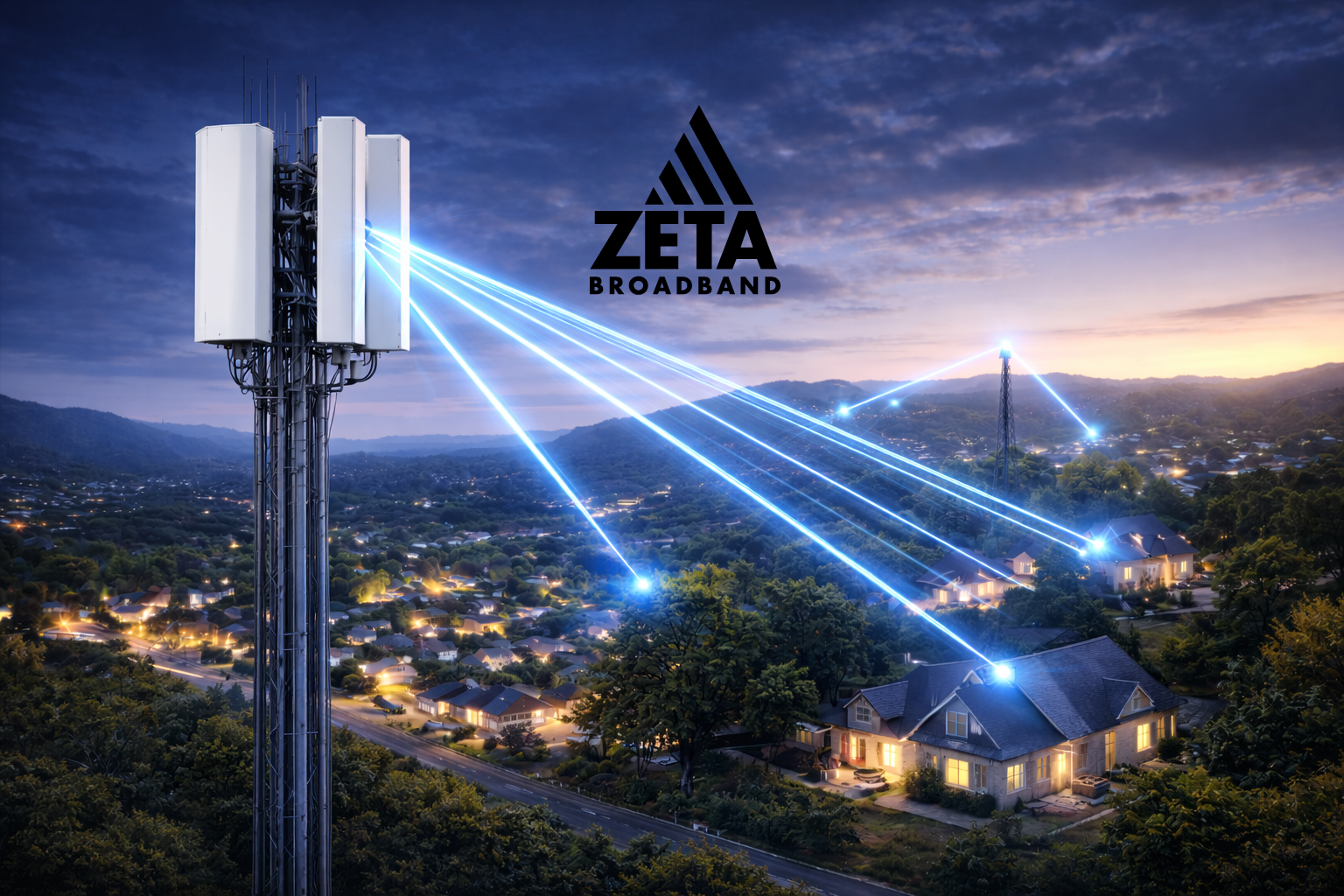
Modern systems instead focus radio energy directly toward each customer using beamforming technology.
This allows the network to:
- deliver stronger signal quality
- improve spectral efficiency
- reduce interference from other devices
The result is a more stable connection and higher data throughput.
Interference Mitigation
Wireless networks must operate in environments where other signals may exist in the same or nearby frequency bands.
Older wireless technologies often struggled when interference levels increased.
Modern fixed wireless platforms use sophisticated algorithms that can detect, analyze, and mitigate interference in real time. These systems dynamically adapt to the surrounding radio environment, allowing them to maintain stable connections even in challenging conditions.
This ability to manage interference is one of the key reasons modern fixed wireless networks perform far better than earlier generations.
High-Capacity Wireless Backhaul
Another major advancement is the use of high-capacity wireless backhaul, often using millimeter-wave spectrum.
Millimeter-wave radios operate at extremely high frequencies, allowing them to transmit large amounts of data across short distances. These links are commonly used to connect network towers and distribution sites, creating multi-gigabit connections between infrastructure points.
This high-capacity transport ensures that the wireless access network has the bandwidth it needs to deliver fast speeds to customers.
Low Latency Performance
Modern fixed wireless systems are also designed with low latency performance in mind.
Latency measures how quickly data travels between your device and the network. High latency can cause delays in video calls, slow response times in online games, and reduced responsiveness in cloud applications.
Advanced wireless technologies are designed to minimize latency, providing a responsive and smooth internet experience for everyday activities like streaming, gaming, and remote work.
Faster Deployment Compared to Fiber Construction
While fiber remains one of the most powerful technologies for delivering broadband connectivity, building fiber infrastructure can be time-consuming and expensive.
Installing fiber often requires trenching, permitting, pole attachments, and construction across long distances.
Fixed wireless infrastructure can often be deployed much more quickly. By installing radio equipment on existing towers or structures and connecting those sites to fiber backhaul, networks can expand coverage to new communities in a fraction of the time.
This allows high-speed broadband to reach areas that might otherwise wait years for infrastructure upgrades.
How Zeta Uses Modern Wireless Technology
At Zeta Broadband, we use next-generation fixed wireless technology as part of a hybrid network designed for performance and reliability.
Our network combines advanced wireless platforms with high-capacity backhaul infrastructure to deliver fast and dependable internet service across the communities we serve.
Technologies such as beamforming, interference mitigation, and millimeter-wave transport allow us to deliver high speeds while maintaining the reliability customers expect from modern broadband.
By combining these technologies with strong network engineering and redundancy, we’re able to bring high-performance internet to areas where traditional infrastructure alone may not reach.
The Future of Wireless Broadband
Wireless technology continues to evolve rapidly.
As spectrum efficiency improves and radio platforms become more advanced, fixed wireless networks will continue closing the gap between wireless and wired performance.
For many communities, these innovations are making it possible to access fast, reliable internet service without waiting for large-scale infrastructure construction.
Modern wireless broadband is no longer a compromise—it’s becoming a powerful and scalable solution for delivering high-speed connectivity.